Groupon laying off 400 employees -- nearly 25% of its workforce -- in AI shift
Published in Business News
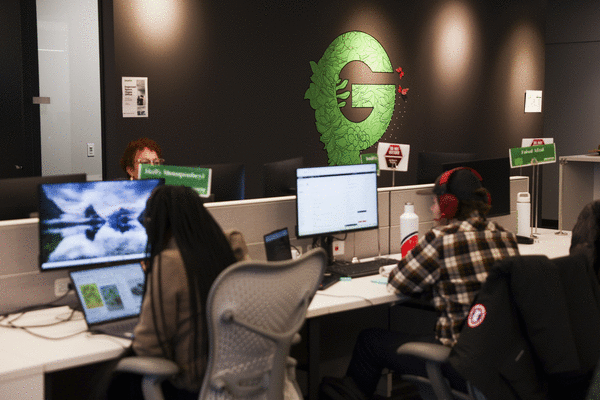
Groupon, the Chicago-based online marketplace, is slashing up to 400 positions — nearly a fourth of its worldwide workforce — in a plan to rebuild as an AI-native company.
Citing projected annualized savings of about $25 million, the company expects to eliminate the majority of the 400 positions by the end of the third quarter, according to a Securities and Exchange Commission filing. Groupon plans to invest up to half of this year’s projected savings into AI infrastructure.
“These are layoffs across the globe, and they’re operational, and it’s to make sure that we are at the forefront of this,” Mike Tepeli, Groupon’s spokesperson, told the Tribune Wednesday. “Our small businesses that we serve are going to be competing with AI. We need to know how to not just use it ourselves, but show our merchants how to use it as an actual partner.”
Groupon had 1,734 employees worldwide at the end of 2025, according to financial filings. The Chicago headquarters had 377 employees at year’s end, including sales, finance and other roles, the company previously told the Tribune.
Tepeli said the Chicago office would be affected by the layoffs — along with Groupon offices worldwide — but declined to offer specific geographic downsizing projections.
Among other things, AI will essentially help Groupon find local businesses that would be interested in using the e-commerce site to sell their goods and services online at a discount, Tepeli said. That could include everything from sourcing leads to sending follow-up emails.
“We are not fully replacing our sales team,” Tepeli said. “We are building in AI layers.”
In addition to sales, the AI initiative will also reduce staff across software engineering, customer service and human resources, increasing Groupon’s operational efficiency tenfold, Tepeli said.
Unlike previous downsizing efforts at Groupon, which reduced ranks at the once golden startup from more than 11,000 to less than 2,000 employees amid declining revenue and operating losses over the past decade, the company is framing the AI shift as a proactive decision.
“This is about how work gets done, not head count targets, and we are redesigning our workflows so AI agents handle operational work end-to-end, and people focus on judgment, strategy and relationships,” Tepeli said.
Groupon launched in 2008, creating its own e-commerce niche with heavily discounted daily deals on everything from manicures to meals, blasted out to subscribers via email. It exploded in popularity, a homegrown Chicago unicorn whose valuation blossomed into the billions.
In recent years, however, Groupon has faced existential struggles.
When Dusan Senkypl, a Czech investor and the company’s largest shareholder, took control of the e-commerce site in 2023, Groupon issued a “going concern” warning to investors that the company could be out of business within a year.
Groupon’s turnaround strategy included cost-cutting measures, such as breaking the lease on its massive River North headquarters at 600 W. Chicago Ave., once teeming with thousands of millennial employees. In January 2024, Groupon moved downtown to sublease a 25,000-square-foot floor of the Leo Burnett Building at 35 W. Wacker Drive, with a local workforce that had dwindled to 150 employees.
But the company has shown signs recently that a renewed focus on hyperlocal daily deals and experiential offerings was gaining momentum. Last year, Groupon saw billings and revenue tick up to $1.67 billion and $498 million respectively, after bottoming in 2024.
Meanwhile, the Chicago headquarters had more than doubled to 377 employees, including sales, finance and other roles, with Groupon adding a second floor last year to accommodate the increased activity.
This year, first-quarter earnings did not reflect projected growth, with global revenue flat and billings down 1% year-over-year.
“We are rebuilding Groupon as an AI-native company to operate at the velocity the era of agentic commerce demands and better deliver on our mission, serving both customers and merchants,” Senkypl said in a May 7 earnings release. “Q1 results do not yet reflect this work, but the pace of AI adoption across every team gives me confidence in stronger performance ahead.”
In a statement Wednesday, the company reiterated that the margin economics of scaling up local commerce do not support a “human-bandwidth solution.” Enter artificial intelligence as a more efficient growth solution.
Even with the 50% reinvestment into AI infrastructure, Groupon projects $5 million of net savings in fiscal year 2026 and $7.5 million the following year. Earnings guidance has been raised accordingly.
In the end, the original e-commerce daily deals site is hoping to get ahead of the AI revolution — before it’s too late.
“Groupon has historically been a step behind on operating-model shifts, on mobile, on cloud, on streamlining,” Tepeli said. “Every time the company waited, it cost time, talent and market position. The AI-native shift is happening now. We are choosing to move while the window is open.”
In addition to the 400 layoffs, Groupon will have one voluntary C-suite position to fill in Chicago. Jiri Ponrt, a partner with Senkypl in Prague-based Pale Fire Capital, Groupon’s largest investor, told the company last week he is stepping down as chief operating officer in July.
©2026 Chicago Tribune. Visit at chicagotribune.com. Distributed by Tribune Content Agency, LLC.










Comments