Schools, police risk losing revenue under Florida Gov. DeSantis' property tax plan
Published in News & Features
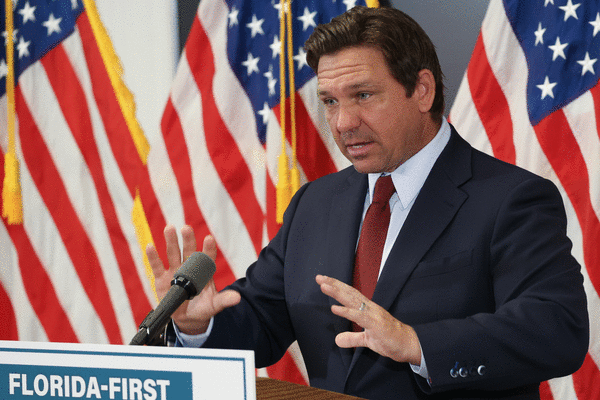
TALLAHASSEE, Fla. — The long-awaited property tax plan touted by Gov. Ron DeSantis is now in writing — and not only does it drastically cut how much local governments can raise from homeowners, it also ties officials’ hands on how they can spend it.
What concerns some state lawmakers and local officials the most is that it doesn’t protect school districts from those dramatic tax cuts, nor does it have a carve-out for law enforcement — two features that had been included in the state House plan offered during the regular session ending in mid-March.
Instead, after all the cuts are made, schools will have to fight over whatever revenue remains with law enforcement, fire departments and other first responders, public works and emergency management officials.
The plan also fails to mention how state constitutional offices that rely on county property tax revenue – tax collectors, property appraisers and election supervisors – would be funded.
And despite DeSantis saying he hopes to eliminate all “homesteaded” property taxes — the term for taxes on owner-occupied homes — in reality his resolution falls far short.
Eliminating all homesteaded property taxes would result in $18.5 billion in lost revenue for all local governments and school boards statewide, according to the non-partisan Florida Policy Institute. Counties and school boards get about 36% of their revenue from taxes on homesteads, which is what people claim as their primary residence. Cities statewide get about 28% of their revenue from homesteaded properties.
The tax exemptions proposed by DeSantis wouldn’t result in nearly that much of a loss initially. But ultimately, he said he would like to see property taxes eliminated for 92% of homesteaded properties.
“Gov. DeSantis can call for property tax reductions, but the reality is those cuts would come at the expense of essential public services residents rely on every day,” said Orange County Mayor Jerry Demings, a Democratic candidate for governor. “You cannot dramatically reduce local revenue without impacting public safety, infrastructure, transportation, and other critical community needs.”
DeSantis had been beating the drum to eliminate property taxes for more than a year before he finally filed his proposal with the Senate late Wednesday.
Titled “Save Our Homes from Excessive Property Taxes,” it calls for a November ballot measure to amend the state constitution to allow the Legislature to reduce property taxes on a large portion of homesteaded properties via massive property tax exemptions.
The proposal was submitted along with a separate document outlining the changes in state law needed to be implemented if voters approve the resolution. Both are currently in bill form on the Senate’s website.
The Legislature will take up the bills in a three-day special session that begins Monday.
To get it on the ballot, at least 60% of both chambers would have to approve the measure, and then 60% of Florida voters would need to vote for it to make it official.
The written plan differs significantly from what DeSantis touted in a news conference Wednesday and circulated on social media, as well as the ballot summary statement that states it “exempts the first $250,000 of a homestead’s value from taxation and requires, through general law, a schedule for full elimination.”
The actual resolution calls for a $150,000 exemption on all homesteaded property in 2027, not $250,000, and then a second-year reduction of all properties valued up to $250,000, not $500,000 as DeSantis said Wednesday. It does not refer to any future increases in property tax exemptions or contemplate eliminating all property taxes completely, despite what DeSantis said.
According to the Office of Economic and Demographic Research, only about 47% of all homesteaded properties in Florida are valued at $250,000 or less.
The resolution also says the exemption will apply only to people who have owned their home for at least five years.
Meanwhile, DeSantis said rural counties with a smaller tax base would receive money from a state trust fund, though the proposal contained no details about that, including where the money would come from.
Especially concerning to city and county officials is that they can only use the remaining property tax revenue on “core services” including public safety, education, infrastructure, flood control, and retirement benefits for local government employees. But it’s not clear how the remaining tax revenue would be divvied up, or by whom.
“Nothing in it ensures that public education funding will be protected,” said state Rep. Anna Eskamani, D-Orlando. “They refer to these core services and list out different ones, but how can you ensure funding when there are no revenue sources left?”
The governor’s proposal is the ultimate preemption of local government that would force cities, counties and schools to go to Tallahassee with hat in hand begging for money, she said.
“All this is consolidating power at the state level,” she said, “while undermining the essential services our communities depend on like public safety, infrastructure, libraries, parks, and more.”
The bill’s first stop in the Senate will be in the appropriations committee Monday, where much debate and possibly amendments will likely be offered to address the issues raised about education funding and clarifying language providing relief for small businesses, said state Sen. Don Gaetz, R-Niceville.
The resolution says that starting in 2029, the annual adjustments of assessed value for inflation on properties would not go higher than 5% a year — half of the current 10% annual cap. But nowhere does it specify any savings targeting small businesses.
If the referendum goes to the ballot and is approved by voters, more fine-tuning will have to occur when the Legislature adopts language either in the 2027 session or a special session after the election to allow the state to implement the new law.
“Obviously, the implementing bill will be complicated, especially as it relates to school funding. But the thrust and the impact will be very positive for Florida taxpayers,” Gaetz said.
If voters approve the ballot referendum, cities and counties will have to turn to other sources of revenue to make up the shortfall to meet the demand in services, including raising fees or charges.
“You will likely see that happen more and more for certain services,” Seminole County Property Appraiser David Johnson said.
_____
Martin E. Comas and Stephen Hudak contributed to this report.
_____
©2026 Orlando Sentinel. Visit orlandosentinel.com. Distributed by Tribune Content Agency, LLC.






Comments