The latest on Pacific gray whales
Published in News & Features
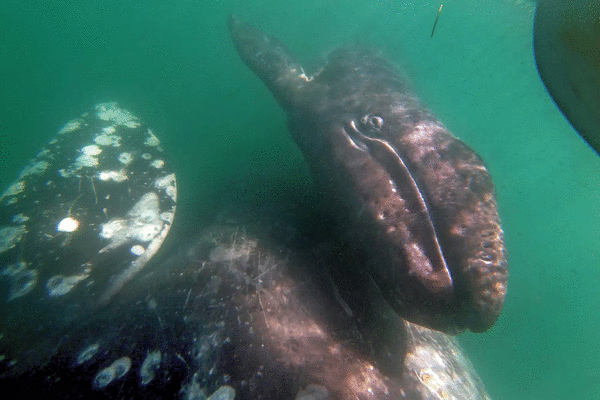
Gray whales are washing up on North America’s Pacific coast in alarming numbers, again. The culprit: Starvation and a lack of food. It feels like it’s becoming a theme this year, as we watched thousands of seabirds die earlier this spring presumably from a similar problem. With a super El Niño on its way, is it just going to get worse?
It’s looking like another really bad year for gray whales.
Thus far, 23 have stranded or died along the Washington coast — outpacing the strandings recorded during the historic 2019 die-off.
The number has been more modest farther south. There have been 20 beachings and deaths in California, down from 30 as of this time last year, but up from 10 in 2024. And there have been eight in Oregon, which according to Michael Milstein, a spokesman for the National Oceanic and Atmospheric Administration, is also a record.
He said a total of 122 have stranded or died this year in coastal waters from Mexico to Canada. That isn’t the highest the agency has ever recorded, but it is similar to between 2019 and 2023, when the federal government called for an investigation of the dying animals.
Early reports from the lagoons of Mexico’s Baja Peninsula, where the leviathans winter every year — birthing, nursing their young, and relaxing in the warm shallow waters — forewarned scientists. Just eight mothers and calves were spotted in Laguna San Ignacio, down from a peak of 274 in 2015, and well below the 40 seen in 2019.
The numbers suggest a continuing decline in the population of Eastern Pacific Gray whales, a species that was once on the brink of extinction due to whaling, but made a remarkable comeback in the 1970s and 1980s. For years, the gray whale was the poster child for sound conservation policies, such as the Marine Mammal Protection Act, showing that when governments intervene, species can be brought back from the brink.
But with the continued warming of the oceans, and the ensuing changes in food availability, animals such as gray whales — and as we saw, earlier this spring, sea birds— are dying.
“The common finding is malnourishment, reflecting an issue with their food supply in the Arctic,” said John Calambokidis, a senior research biologist at the Cascadia Research Collective, a whale research organization in Washington.
After wintering in Mexico, gray whales migrate 6,000 miles north along the Pacific Coast to summer feeding grounds in the Arctic and Sub-Arctic oceans. There, they find small crustaceans and amphipods in the muddy sediment of the Bering, Chukchi and Beaufort seas before they head back south, where they won’t feed again until they migrate north the following year.
But the reduction in sea ice and warming waters appears to be disrupting the availability of their mud-dwelling morsels, making them travel farther in search of food and providing less sustenance all together.
Other animals are also affected by the warming waters, as witnessed this spring when thousands of sea birds — including Brandts’ cormorants, brown pelicans, grebes and loons — died along the California coast. While researchers can’t say they all died from starvation, many of the animals appeared malnourished. And scientists say when animals don’t get enough to eat, they often exhibit riskier feeding behavior, and their immune systems become depressed — leaving them vulnerable to fungal and other infections.
Kathi George, director of Cetacean Conservation Biology at The Marine Mammal Center, in Sausalito, said researchers have spotted 16 gray whales in San Francisco Bay this year — a place where gray whales were not seen historically before 2018.
She said they appear to be feeding in the Bay, as they are in other inlets up and down the coast, looking for new places to find food. Necropsies show they are finding food, but the heavily trafficked waters put them at grave risk of entanglement and vessel strikes. She said four of the seven animals that have died in the Bay this year were likely hit by boats or ships.
Theresa Mercer, who along with her husband, Scott Mercer, founded the Point Arena Mendonoma Whale and Seal Study in 2013, said they saw 344 northbound whales this year, including seven mother-calf pairs. She said those numbers “reflect what we used to count in 7-10 days in 2014-2018!”
As scientists warily monitor what could become a super El Niño roiling in the Pacific, and a sustained marine heat wave seemingly locked in off the coast, they’re hoping these “jeeps of the ocean” — generalist whales known for their hardiness and resilience — can pull through this latest crisis.
_____
©2026 Los Angeles Times. Visit at latimes.com. Distributed by Tribune Content Agency, LLC.






Comments