Billionaire businessman Tilman Fertitta to acquire Caesars in $17.6B deal
Published in Entertainment News
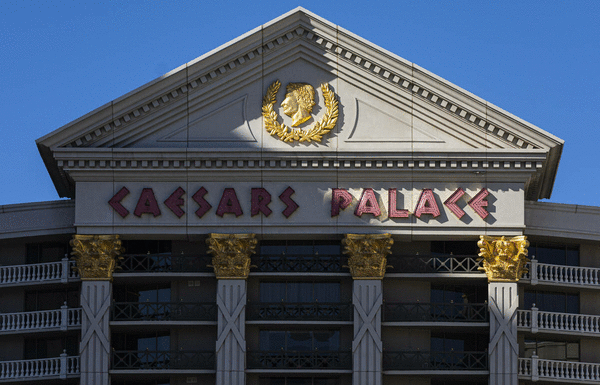
Billionaire businessman Tilman Fertitta is expanding his hospitality empire by taking over a U.S. casino giant.
Fertitta Entertainment Inc. is acquiring Caesars Entertainment Inc. in an all-cash deal announced Thursday valued at $17.6 billion, which includes roughly $5.7 billion in equity value and an assumption of nearly $11.9 billion of Caesars’ outstanding debt.
Caesars shareholders will receive $31 per share, a 49 percent premium over the company’s closing price on Feb. 25, the day before reports of a possible buyout began circulating. Caesars’ board approved the agreement and is urging shareholders to sign off, saying the premium offers “compelling” value.
The deal, which is subject to regulatory approval in each jurisdiction where Caesars operates, would create one of the largest domestic gaming companies.
Reno-based Caesars operates eight casino resorts on the Strip, including its flagship property, Caesars Palace, as well as Paris, Flamingo and Horseshoe. The company also operates four casinos in Reno, three in Lake Tahoe and two in Laughlin. In total, Caesars oversees more than 50 casino resorts across 16 states.
Fertitta already owns the Golden Nugget casino brand — including its downtown Las Vegas property and two other Nevada locations — and holds a double-digit ownership stake in Wynn Resorts Ltd.
Fertitta unsuccessfully attempted to merge his businesses with Caesars in 2018 before Eldorado Resorts Inc. purchased Caesars Entertainment in 2020 for $17.3 billion and merged the two companies.
Fertitta prevailed over competing bid
Despite millions of dollars in reinvestment across its casino resort portfolio since the merger, Caesars has struggled to increase value. After the company’s stock hit a post-pandemic high of $119 per share in October 2021, the stock price has plummeted more than 70 percent in the last five years.
Fertitta renewed his pursuit of Caesars earlier this year, entering exclusive negotiations in March. He ultimately prevailed over a competing bid from activist investor Carl Icahn, whose firm had offered approximately $33 per share. Icahn increased his stake in Caesars in 2024 and placed two directors on the company’s board, but once Fertitta secured exclusivity, Icahn’s offer was effectively sidelined.
According to reports, Fertitta plans to finance the transaction through a mix of equity and new debt secured with partner banks.
Houston-based Fertitta Entertainment is the parent company of restaurant conglomerate Landry’s, LLC, which operates chains such as Bubba Gump Shrimp and Rainforest Cafe. Fertitta also owns the NBA’s Houston Rockets, and is currently serving as the U.S. ambassador to Italy and San Marino. His role as a sitting U.S. diplomat may cause regulators in multiple states to view the ownership structure with additional scrutiny, according to multiple industry sources.
Caesars CEO Tom Reeg, CFO Bret Yunker, and President and COO Anthony Carano are expected to remain in their roles, along with the rest of the corporate and property-level leadership teams, according to a news release. The companies said they plan to maintain continuity while tapping Fertitta Entertainment’s operating model and hospitality portfolio.
Regulatory approval of the transaction is expected to take more than a year given the complexity and scope, according to industry experts. By comparison, Eldorado’s purchase of Caesars was approved 11 months after first being announced, although the bulk of regulatory work was conducted when much of the gaming industry was idle due to COVID-19.
Among the obstacles associated with the current deal are structural considerations tied to Caesars’ substantial debt load and its relationship with VICI Properties, the real estate investment trust that owns many Caesars resorts and leases them back to the operator. Depending on how the transaction is structured, VICI’s consent may be required.
If the deal closes, it is expected that Caesars would become a privately held company, shielding it from the scrutiny of quarterly earnings reports.
The agreement also includes a “go-shop” period through July 11, allowing Caesars to solicit and review alternative acquisition proposals.
Another open question is the fate of Caesars’ digital division. Some analysts have suggested that spinning off the business could be a potential way to raise capital and reduce the company’s debt.
Analysts framed the deal as a full but not overly frothy valuation.
In a note to clients, Chad Beynon of Macquarie wrote that the premium reflects the stability of Caesars’ regional gaming cash flows and the value of its digital division, while still leaving room for Fertitta to create upside through cost controls and portfolio optimization once the company is private. Beynon also noted that a competing bid during the go-shop window appears unlikely given the size of the transaction, the nearly 50 percent premium and the regulatory complexities involved.
Following the announcement, Beynon said Caesars will likely trade in a merger-arbitrage pattern, with shares hovering just below the $31 offer price until the transaction closes, which is not expected until mid-to-late-2027.
Longer term, Beynon suggested the take-private could prompt other regional gaming operators to reassess scale and portfolio mix, potentially catalyzing broader mergers and acquisitions activity across the sector.
___
©2026 Las Vegas Review-Journal. Visit reviewjournal.com.. Distributed by Tribune Content Agency, LLC.










Comments