From Chesapeake to Mars: City worker spent year with NASA on simulated Mars habitat
Published in Science & Technology News
CHESAPEAKE, Va. — In his day-to-day, Ross Brockwell works as the operations manager of Chesapeake’s public works department, where he helps oversee the crews responsible for keeping the city’s water, trash, sewer and road maintenance functioning properly.
But for 378 days throughout 2023-24, he was one of four living on Mars.
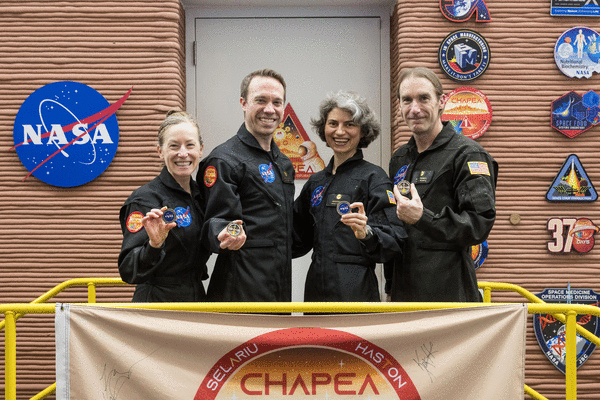
Brockwell, 48, spent around a year fully immersed in a simulated version of Earth’s neighbor as part of NASA’s Moon to Mars program. He was selected to serve as a flight engineer for an experimental expeditionary mission at the Johnson Space Center in Houston intended to help inform future trips to Mars.
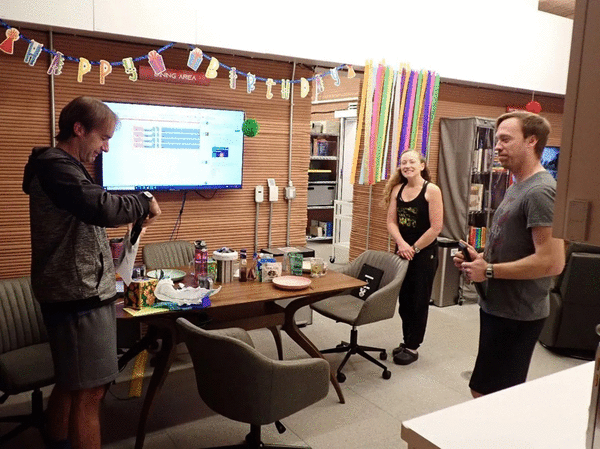
Using 3D printing and virtual reality technology, NASA converted a hangar into a full-scale prototype habitat simulation where he and the crew slept, ate, exercised and lived. Outside of the hangar was an external Martian-like surface that required the use of a space suit and helmet. As one would expect of the “red planet,” Brockwell described a simulated red and rusty hue and a dusty, dry, thin atmosphere.
“But it was all in Houston, Texas,” he said.
NASA made the call for applications in 2022, and Brockwell applied after several friends encouraged him to do so. The application called for “astronaut-like” qualities, such as problem-solving and teamwork skills, and included a period of rigorous vetting to assess medical, psychological, physiological and survival capabilities. Brockwell and three others were selected from a pool of at least 4,500 applicants for a study that would span the summer of 2023 through summer 2024.
Brockwell’s days consisted of group meals, daily exercise, habitat maintenance, group and individual missions and exploration. The study also included food science with trials to test food systems and nutritional needs, along with assessments on crew interactions and communication.
“NASA’s plan is to kind of have the moon be a way station, so to speak, and the next phase would be the moon establishing a presence there and using the moon to launch to Mars. So this is a part of a sequence that they have planned to get to Mars,” Brockwell said. “This study is going to heavily inform the real mission, and hopefully help them make good design decisions and good crew selection decisions.”
Food ranged from dehydrated or freeze-dried meals to dried fruits and shelf-staples, along with a successful hydroponic garden where the crew grew fruits and vegetables — their closest connection to planet Earth. A variety of thermo-stabilized food was important for the crew so that they didn’t get bored and neglect their nutrition, he said.
And though space was limited, each brought some personal belongings. Brockwell brought photos, posters, and digital and physical books including the “Mars Trilogy.”
They celebrated holidays together, and used the 3D printer to create a basketball hoop. They created a makeshift “Netflix setup” for movies. And though it arrived to them days late due to the communication delay, Brockwell and the crew were able to watch what’s been dubbed the longest Super Bowl game in history.
“For the most part, it went by really fast. I never felt strained or impatient. It was pretty easy to imagine being in the real scenario with the way they set up the simulation,” he said. “It shows that a crew like that can do more than just manage. They can still maintain enthusiasm and inspiration and creativity and have a good time doing it.”
And though his day job in Chesapeake isn’t quite the same as working with a crew on “Mars,” Brockwell said “some things are universal.”
“There are a couple of hundred people here that I have to help coalesce and inspire, and it’s really satisfying to play a part in helping people communicate effectively and work together effectively. It was true for the four of us on Mars, and that’s true for our department and for the city as a whole, and that’s scalable,” he said.
Leaving the simulation felt like returning back to Earth for Brockwell. The Virginia Beach native craved seafood, but in his first meal “back” opted for what he called the astronaut tradition: “a good old-fashioned cheeseburger.” He also recalls a renewed gratitude when experiencing sunlight on the skin, blue skies and “a horizon from a proper distance.”
Brockwell said humans have a need to explore and learn, and that experiments like this can help humanity better understand the value of Earth and prompt better cooperation across the globe.
“It reminds you of how precious the planet is, and how incredible the things humanity can achieve are, and the fact that we hold a place in the ecosystem and the web of life. And it’s easy to lose sight of that,” Brockwell said. “Resources and where we spend our energy are critically important, but I think these kinds of endeavors help remind us of what’s possible and help us reconnect to the place that we have in the universe. I don’t think it’s either/or, and I think that the space program absolutely does not try to insinuate that planet Earth is replaceable or insufficient.”
_____
©2026 The Virginian-Pilot. Visit pilotonline.com. Distributed by Tribune Content Agency, LLC.





Comments