David M. Drucker: Why MAGA Republicans keep winning when Trump is losing
Published in Op Eds
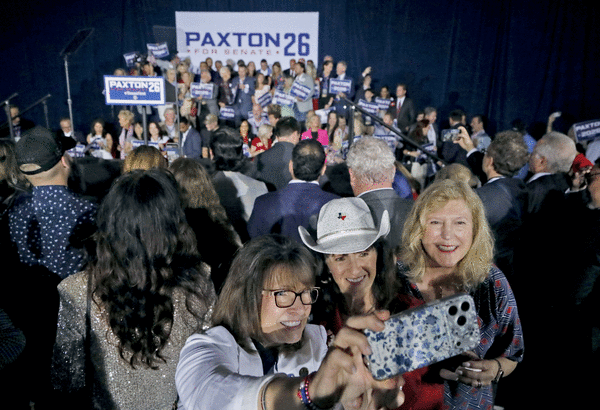
President Donald Trump’s grip on the Republican Party is slipping. Sort of. Because even though the president’s support among GOP voters has diminished, his demonstrable strength is still swaying the party’s primary contests.
The Indiana state senators who quashed the president’s redistricting scheme there? Several were defeated for renomination on May 5. Senator Bill Cassidy of Louisiana, who voted to convict the president at his second impeachment trial? Defeated on May 16 after Trump called him a “sleazebag” and a “terrible guy.” Representative Thomas Massie of Kentucky, who Trump opposed as revenge for collaborating with Democrats to force the release of the Epstein files? Defeated on May 19. Senator John Cornyn of Texas, the loyal foot soldier who the president thought wasn’t loyal enough? Defeated in a Tuesday runoff by scandal-plagued, Trump-backed state Attorney General Ken Paxton.
There are more examples of Trump’s prowess in GOP primaries. But you get the picture. So how does that square with his increasingly precarious political standing?
Republicans in the US Senate are balking at the president’s request for a billion-dollar White House ballroom, and they’re in open revolt over the creation of a $1.8 billion slush fund within the Justice Department aimed at rewarding the president’s political allies, including Jan. 6 participants convicted of violent felonies. Republican voters, the bulwark of the president’s political power, appear similarly exasperated. Just 57% “strongly approve” of his job performance, down from 75% in January, according to a fresh Wall Street Journal poll. (His job approval rating with all voters has dropped below 40%.)
Yet candidates backed by the president — and his social media megaphone — are still scoring decisive victories in Republican primaries. That’s because they’ve come in ruby-red territory, in contests closed to unaffiliated voters or both. Such primaries allow committed Republican voters to dictate the outcome. And more than a decade into Trump’s rule of the party, these committed, or “base” voters, typically think of themselves as MAGA first and Republicans second.
“In closed Republican primaries, MAGA, led by Trump, is going to dominate,” Jeffrey Brauer, a political science professor at Keystone College in Pennsylvania, told me. “When Trump endorses challengers, in most cases the media/social media coverage and funding sources that follow the endorsement often are enough for them to win, even against long-time incumbents.”
When I interviewed Cornyn for The Dispatch in January, he told me that his bid to hold off Paxton would test “whether a normal, Texas conservative Republican can still get elected in a primary.” Considering who the Republican base voter is today, it’s no wonder Trump’s endorsement of ultra-loyal Paxton sealed Cornyn’s fate.
The problem for the president, and by extension, Republicans in Congress defending vulnerable majorities in midterm elections this fall, is this: The GOP coalition has more to it than the unshakably pro-Trump base voter. Republican pollster Kristen Soltis Anderson expertly laid this out in a recent column for The New York Times. The 45th and 47th president, she explained, is losing support among “normie Republicans.”
These voters are generally supportive of Trump. They tend to watch Trump-friendly Fox News, self-describe as conservative and are firmly opposed to liberal policies and Democratic politicians. However, they identify primarily as Republicans instead of pro-Trump or MAGA and wish the president’s agenda was delivered without the provocative behavior and combative social media posts. Oh, and these normie Republicans make up roughly half of the GOP coalition, according to Anderson.
The group’s drift from Trump’s orbit could cost Republicans seats in Congress (and elsewhere) this November — even though it’s not currently impacting tense GOP primary races.
The Democrats now lead the generic ballot, gauging which party voters would prefer to control the House and Senate, by an average of 7.7 percentage points. Simultaneously, normie Republicans’ burgeoning disenchantment with Trump — which is translating into disinterest in participating in the political process this year — is further empowering the president in congressional nominating contests.
“There’s a large gap in voter enthusiasm between MAGA and non-MAGA Republicans,” Anderson told me in an email. “When non-MAGA Republicans tune out and stay home, this has two downstream consequences: In a general election, it jeopardizes Republicans’ midterm hopes, while at the same time supercharging the influence of MAGA in lower-turnout contests like primaries.”
Imagine Trump and the Republican coalition as Saturn and its rings. (Maybe you think the president best represented by Jupiter, a gaseous giant, but stick with me.) Right now, the rings furthest from the planet are disintegrating and drifting into space. What if this keeps happening, until roughly 50% of the ones closest — those too caught up in Saturn’s gravitational pull to drift — are all that’s left?
The Saturn that remained would still be a significant planet. In political terms, it would be enough to grant Trump near free reign in Republican primaries and for the party to maintain control of deeply partisan congressional seats. But it would hardly be an awe-inspiring celestial body, the kind that enabled the president to win reelection in 2024 with a diverse voter coalition, preserved Republicans’ majority in the House and vaulted them into control of the Senate.
That’s the best way to understand Trump and the state of the GOP coalition right now: significant but not impressive.
____
This column reflects the personal views of the author and does not necessarily reflect the opinion of the editorial board or Bloomberg LP and its owners.
David M. Drucker is a columnist covering politics and policy. He is also a senior writer for The Dispatch and the author of "In Trump's Shadow: The Battle for 2024 and the Future of the GOP."
©2026 Bloomberg L.P. Visit bloomberg.com/opinion. Distributed by Tribune Content Agency, LLC.


















































Comments